





The Danville Area Humane Society lowered its yearly euthanasia rate to 65% last year — down from nearly 80% in 2023 — as a movement continues from a newly formed group to obtain a no-kill status in the city.
The report posted last week shows that 2,213 of the 3,362 animals brought into the shelter were euthanized.
However, the kill rate is much lower when factoring in injured and sick animals euthanized by veterinarians before coming to the shelter, Danville Area Humane Society Director Paulette Dean explained in an interview with the Register & Bee.
When those things are factored out, the kill rate drops to about 50%, she said.
“So, we are pleased, but, to us it proves something,” Dean said. “And that was that 2023 was a low point for most shelters and rescues in the animal welfare world.”
People are also reading…
The Danville animal shelter came under scrutiny after 2023’s numbers showed 4-in-5 animals were euthanized.

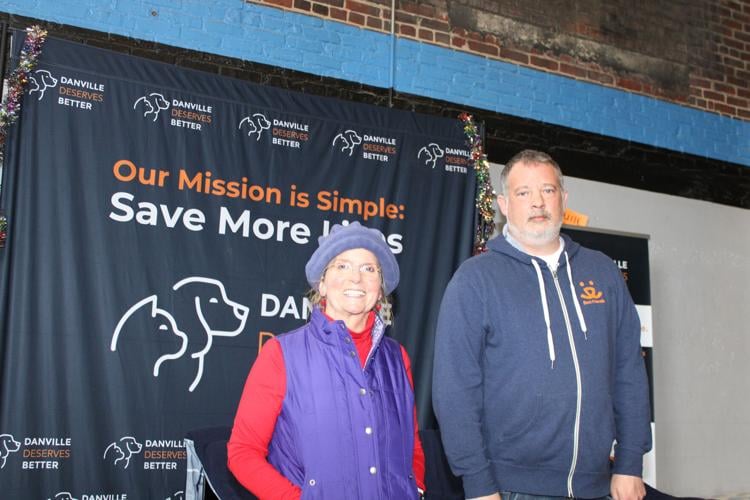
Dave Wesolowski, manager of grassroots advocacy for Best Friends, and volunteer Sue Ellen Lawton, stand Wednesday in the campaign headquarters for Danville Deserves Better, a group pushing for a no-kill status animal shelter.
A local group — Danville Deserves Better — is part of the national Best Friends network that has a goal to have shelters across the nation adopt a no-kill strategy by this calendar year, Dave Wesolowski, manager of grassroots advocacy, told the newspaper Wednesday at the group’s campaign office on Lynn Street.
The term no-kill means that an agency has a 90% live-release rate. Wesolowski noted that there always will be animals that come in injured or sick that need to be euthanized.
Best Friends presented an offer to the Danville Area Humane Society to somewhat partner in efforts. The local group turned down what was presented.
“We firmly believe Danville can be no-kill,” he said.
The Danville shelter is considered open-admission, meaning animals are accepted no matter the reason for surrendering. No-kill shelters may sometimes turn down animals because space isn’t available.
Wesolowski is still concerned by the 2024 rate in Danville, even though progress was made.
“But it kind of gives us energy and acknowledges that we are going in the right direction,” he said.
When the campaign started, he heard that it wasn’t possible to lower the numbers at the Danville shelter.
He said the data proves otherwise.
Dean stressed that 2023 was anything but a typical year, not only locally but on the national level also.
“We are glad that numbers went down,” she said. “We still need people to understand that we know our 2023 numbers looked bad, however, we understood the numbers because we lived them.”
There were 3,362 animals brought to the Danville shelter in 2024, compared to 3,499 the year earlier, a slight drop of 137.
Danville received 1,249 animals from other localities, an increase of 184 from the year prior.
Why the drop?
Dean credits being able to transfer more animals from the shelter with the drop in the kill rate.
“The transfers were up in 2024 because as things began to calm down and numbers began to calm down, then our transfer partners were able to take more animals from us,” she explained. The year before, other agencies were in the same situation dealing with an influx of animals and they weren’t able to take ones from Danville.
The Danville shelter director hopes this is a sign that things are starting to stabilize.
“But whatever is happening in human society affects animals,” she said.
“So it all depends upon the economy,” she explained. “When things are going well, people can afford to have animals.”
In fact, the economic picture is the No. 1 reason animals come to the shelter. The second is when people move and a new landlord won’t allow the pets.
“We are anxiously following things that happen in society,” she said of where the country is going. “What is going to happen with the economy because that has a direct influence.”
Wesolowski was also hopeful to see the transfers increase.
“It’s not just the percentages, you think of the number of animals that have been saved, it’s really encouraging to see,” he said. “It’s still a long way to go and a lot to do.”
Sue Ellen Lawton, a volunteer for Danville Deserves Better, pointed to increasing transfers, fosters and easing adoption regulations as other avenues to help get animals out of the shelter and into homes.
Lawton is one of two from Danville Deserves Better on a strategic planning committee for the Danville Area Humane Society.
“It’s been a really nice experience,” Lawton said. “Everybody’s got the same good intentions.”
The committee is tasked with coming out with a new strategic plan with a goal to “reduce the number of homeless, neglected and abused animals while remaining a truly open-admission shelter.”
It started in October. A final meeting was set for this week, Dean explained, where the board was expected to get a draft of the plan.
“With the final report, we will release that to the public,” she said.
Lawton told the newspaper that she was relieved that Danville Deserves Better came to the city last year. She had wanted to volunteer at the humane society, but was put off by the high kill rates.

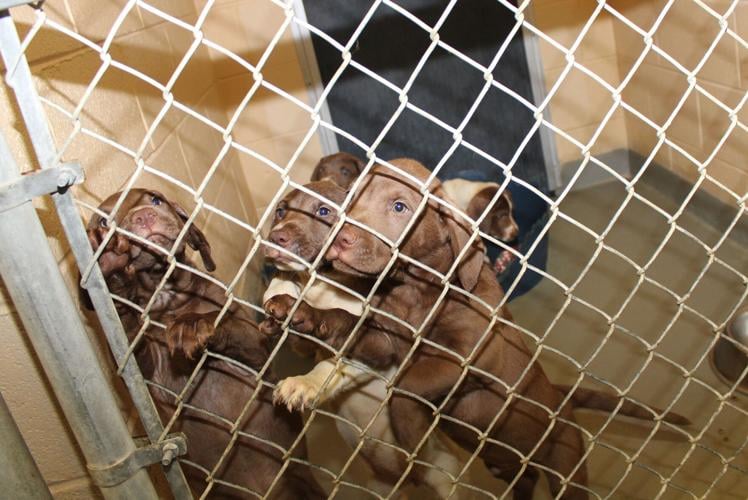
Dogs up for adoption scratch at a kennel gate June 26 at the Danville Area Humane Society.
Opposing forces
“I wish the community and the shelter could work more closely together,” Lawton said.
“So there is not such animosity,” she continued. “I feel like there’s so many people that would volunteer for the shelter if we could break down those walls.”
Tempers flared last year as the two groups battled sometimes openly on social media over the best practices for animals.
Danville Deserves Better became a fixture at Danville City Council meetings, with members voicing concerns on practices at the local shelter and, in particular, highlighting the 80% kill rate in 2023.
For residents, it appears there’s a line-in-the-sand on taking one side or the other.
It’s not uncommon for emotions to be high, according to Wesolowski. He sees the same thing play out across the nation.
“When a shelter starts going down this path and you have these high euthanasia rates,” there’s a rift between the community and the shelter, he explained.
That’s when both sides dig in. He said the solution is for a shelter to look inward, examine practices and see what they could be doing better.
“And then invite the community in to help make those changes,” he said.
But it has to be a “put down their knives” atmosphere on both sides, Wesolowski noted.
“It has quieted down a little bit, but we are like everyone else, we just read things on Facebook,” Dean said when asked how things appear to be heading now, compared to last year.
She said they haven’t had any personal communications with the Best Friends organization after not accepting the proposal, however members continue to seek records via the Friend of Information Act.
“When the final 2024 FIOA is ready, they will pick up those records and we expect that those intakes will be posted and picked apart,” she said. “We’ll take it one day at a time as it comes to us.”
One point of criticism — the lack of a computerized program to track intakes — has changed at the Danville Area Humane Society, courtesy of the city of Danville.
“Yes, we do have a computer program with intakes,” Dean confirmed with the newspaper, explaining employees are training on it.
Every intake from Jan. 1 will be available in digital format, although paper copies will still be kept. She said the city was footing the bill for the software, something that previously stated could cost in the thousands of dollars.
“I will be honest, 2024 was a very difficult year for our employees,” she said of the attacks concerning the shelter. “We did everything we could to keep them happy.”
That included raises and bonuses for the “good team” working there.
“2024 was a soul-crushing year,” she said.
“But our souls weren’t crushed,” she continued. “Bruised perhaps, but not crushed.”
The lower kill rate shows Wesolowski that progress can be possible.
“Just by embracing simple changes you can really get those numbers up,” he explained of saving animals. “And you can build on that.”
In the end, that will make staff at a shelter happier, and please the customers and community.
“When you have a shelter that is trying, that is doing everything it can to find every animal that comes in its door, that’s adoptable, a forever home, it’s tough work,” he said.
“It’s draining,” he continued. “It’s emotion.”
Other help
To help in the effort, Danville Deserves Better provides free pet food for owners who need help.
In two months they have given out more than two tons.
“It’s people who might turn in a pet to the shelter because they think they are doing the right thing by the pet,” Wesolowski said, explaining an owner may not be able to temporarily afford food. “It’s been really successful so far.”
There’s a calendar on the group’s Facebook page detailing when the pet food pantry is open. The food comes from partners like Blue Buffalo, which donates it by the pallet.
After the City Council appearances proved not to invoke action, Danville Deserves Better is focused more on the community now.
“We’re still here, we’re still looking for the solutions and we’re happy to talk to anyone,” Wesolowski said.
There appears to be one area both sides share in agreement: the solution will come from the community.
“The pets don’t create this problem,” Wesolowski said.
“It’s a people problem,” he continued. “That requires a people solution.”
Dean said the community can help by spreading the word about its spay/neuter assistance program, which this month has increased discounts for residents.
“As always, just spread the news about microchipping,” she also said, something the shelter offered last year.
“We want to continue that work,” Dean said. “When an animal comes to a shelter and has a microchip, we are just so happy, because we know the chances are that animal will be returned home.”
Both said keeping animals at home would solve a lot of problems.
“Animals that are allowed to wander will have a greater chance of becoming a lost animal than onces that are kept confined on a leash,” Dean said.
In the end, Dean said there are many things the public can do to aid the shelter.
“And perhaps communities have relied on shelters to just clean up ‘the mess’ and now maybe, Danville and Pittsylvania County, there is a greater awareness that it is not a shelter problem, it is a community problem,” she said.
“We all love animals and we want the best for them,” Lawton explained. “If we can put our emotions aside and focus on them, I think we could make some real headway.”